The Multi-camera technique is were more than one camera is used to shoot a production at the same time. The kind of programs which use this technique are: chat shows, reality t.v, panel shows (e.g 8 out of 10 cats) and sitcoms. Generally any live shows use this setup as this way all the action happening on stage and in the audience can be captured and the director can switch between cameras. This creates an exciting atmosphere as the laughter and applause from the audience is real and the cameras can capture the reactions of the people involved.
There are advantages to using the multi-camera set up rather than the single camera set up. Although more cameras are needed, it it cheaper to shoot a production using a multi-camera set-up and takes less time as a scene onlyneeds to be performed once. As there is more than one camera, the different angles and shots can betaken at the same, therefore it saves a lot of time compared to the single camera set-up.
The picture above is of a basic multi-camera set up. For a multi-camera shoot, two or more cameras will be placed in different positions in the studio facing the particular scene in question. The cameras being used will be filming different shots and angles which the director can switch to during a show (particularly in live programs). For example, (using the picture above) Camera 1 could be a close up of character A, Camera 2 could be a medium shot of both characters, Camera 3 could be an establishing shot of the entire scene including the background and lastly camera 4 could be a close up of character B. Using these different shots, the director can make interesting show, with a variety of angles.
This clip begins with an establishing shot of the stage with Liam Mower in the centre, which shows that he is the focus point of the clip. The camera zooms towards Mower to a medium shot which shows the audience the face of the main character. There is then a transition to a camera which is positioned in almost a birds eye shot as it moves closer to the charcter, to an extreme medium shot, then the camera zooms out to another establishing shot. Throughout this clip there are transitions from camera to camera on different shots. Also the camera is contantly moving which makes it more interesting for the audience to watch, as at the beginning the character is stood in one place when me is singing. As the music changes and he begins dancing, the camera shots work in the same way, zooming in and out from establishing shots to medium shots, however because the pace of the music has become more upbeat, the transitions are quicker and shorter to fit with the music. Also when he is dancing, there is a close-up of his feet which is effective as it shows the audience his footwork. As he starts singing again, the camera work slows down in accordance with the tempo of the music. There is a close-up of his face which brings the audiences focus back to his singing. When the performance is finished, and he is being interviewed the camera work is more still and the transition are quick and sharp rather than slow and zooming as seen previously which emphasises that the performance has finished.
Mcfly - Star girl
This clip, which is also a musical performce is shown differently to that on Blue Peter. It begins with a long shot of Mcfly which shows the audience that they are the central focus of the coming clip. Throughout the clip the camera work is still and there is little movement, however there is variety in the shots as it quickly switchs constantly from camera to camera showing the band and the small audience of two young girls and the two presenters that are watching. This is effective as it shows the reactions and enjoyment of the audience during the performance. The main shots used in this clip are medium and long shots at eye-level which gives the performance a more personal and warm feeling for the audience. There are also close ups of members of the band at times which are effective bacause it shows the emotions and enjoyment that the band members have whilst performing.
TMi - Fearne Cottons sandwiches of doom
The clip begins with a medium shot of Fearne as she starts speaking which shows her importance as she is the presenter of the show, and focuses the audiences attention on her. There is then a long shot from a different angle showing the rest of the people in the room giving the audience a feeling of the situation and the surroundings then it quickly switches back to a medium shot of Fearne. As she is making the sandwiches, the shots are extremely quick and fast paced, also the camera work is still throughout. There is the occasional zoom in/out, however this doesn't last long. These quick shots are effective as it fits with the tone of the clip which is quite fast paced and there is a lot going on, also there are very few transitions which keeps the clip at this fast-pace. There are several close-ups throughout the clip Fearne's hands to show the audience more clearly what shes doing.
Task 2 cont..
1st clip
Throughout this clip, the camera work is varied, starting with an establishing shot of the stage, moving to long shots of different areas. The camera is contastly zooming in/out while transitioning between cameras which maitains the veiwers interest as it gives the feeling that the veiwers are involved and part of the performance. Also there are long shots of the audience, showing that the performance is live which adds to maintaining the veiwers interest, as is shows the realness and talent of the band. The variety of angles and shots communcate the meaning to the veiwers as they are juxtaposed against the band who are stood still for the whole performance. This contrast shows the freedom of expression the band has and the art of their performance.
Task 3 (P1,M1.D1)
Task 4 (P1,M1,D1)
Task 5 (P1,M1,D1)
This is the shooting script and floor plan for our multi-camera program, Friday World.
Task 6 (P1,M1,D1)
Task 7 (P1,M1,D1)
The TV program we recorded was called Friday World and the role i played within my group was Sound Engineer.
Task 8 (P1,M1,D1)
Evaluation
Purpose:
The purpose of our TV program was to entertain, slightly inform and create light-hearted fun atmosphere for our target audience; high school students. We included a variety of short films, to appeal to the different styles of our target audience, these were:
Glee music video (This is very popular with teenagers at the moment)
Valentines Daydream "Scream" spoof (This was as we recorded our program close to Valentines day so we added comedy to the occasion)
Orchestra (This is a filming of a professional orchestra which came to the school, and some students got involved with this)
The conga (Students all participated in doing the conga around the school)
I think we achieved our purpose as the films we broadcasted had comedic and entertainment aspects and also, as it involved students from the school, it appealed to our target audience as they felt they were part of the program. Also the presenters were informative of up and coming events occurring within the school.
Audience:
As we had a live audience when we recorded our program we asked the audience after the production for their feedback and here are some of their comments:
"The camerawork was consistent and there were enough different shots used so that it remained interesting to watch."
"I liked it! It was very entertaining - all the way through."
"There was a part right at the beginning when I couldn't hear the presenters talking which confused me a little."
" I liked how it was quite cheerful and happy."
We were happy with this feedback and I agree with the comment about the sound of the presenters at the beginning and I have accepted that things can go wrong during a live production. I am glad that the program came across cheerful and happy as this ws the mood we were trying to create.
Representation issues:
As our program was for entertainment purposes, we gave out positive messages to create a light, fun atmosphere. For example we had a video of the students from our school doing the conga which was positive as it involved our target audience so it was especially entertaining for them. Our program involved males and females, both with the presenting and in the short films we broadcasted. We had one male presenter and one female presenter to bring different aspects to the program, and also the audience can relate to either one. We did not use different ethnic groups, as we did not have the opportunity to and it wasn't an issue.
As we had several short films within our multi-camera program, there was a number of music tracks used throughout the program. However they were all relevant to the mood we were trying to create of light-hearted, fun entertainment. For example the Glee music videos are very popular at the moment, therefore we chose it because of its entertaining, fun value. The location we used was the Friday world studio in our school. This was appropriate because its position means we can broadcast to the students efficiently. Also the studio was a satisfactory size for the equipment we used and for the presenters.
The language used by the presenters was informal and in their regional dialect which was suitable for the target audience as it is high school students therefore using formal language wouldn't be appropriate. Also they have the same regional dialect, so they could understand and relate to the presenters.
Technical issues:
The presenters used an omni-directional microphone which they both spoke into. It was important to use this microphone rather than a uni-directional microphone as the the sound needed to picked up from different directions. We had some technical difficulties with the sound at the beginning of the recording as we could not hear the presenters speaking at all. However this was quickly resolved by a technician within 30 seconds and we were able to hear the presenters clearly. At the time this cause a panic as we were not sure when the sound would come back, but we accepted that this can happen when recording a live program.
We used two cameras to film the presenters. One camera was set on a low-angle shot, the second camera was set on a medium shot of the presenters and we switched to close ups of each presenter throughout the recording. The camerawork was steady, and we used still shots rather than moving during a shot so not to confuse the audience. There was a slight hiccup at one point were the camera went to an extreme close up of one of the presenters faces, but this was quickly solved by moving out to a close up. I feel that there was enough variety to keep our audience interested, as the cuts to the presenters were short and sharp, and we used a number of shots.
Conventions/Narrative:
The following things are what i think is typical of the genre we chose:
-Comedy
-Informal
-Visual Effects
-A Variety of shots
-Bright colors
-Upbeat, appropriate music
-Entertainment
-Slightly inform
I think aspects of our program were similar to that of a professional product. We used bright, colorful backdrops behind the presenters which is a technique used by professionals in programs i have seen which are similar to our genre. The music we used throughout the production was upbeat and cheery which added to the mood we wanted to create of fun, happiness and entertainment which is similar to what professionals would do.
Professional producers will have many advantages compared to us. They will have a considerably bigger budget than us which will allow them to purchase high quality equipment and have a wider variety of music and sound effects. Also they have access to a large team of professionals which would mean that the production would get finished faster, saving time and money. Overall professional producers can produce a substantially better outcome.
Self evaluation and future targets:
I learnt many new skills during the filming of our multi-camera production. There were many different aspects involved, which I got to observe. The main skill I learnt was controlling the sound, as my role was sound engineer, however I also learnt about the different roles required for a multi-camera production. I was a little nervous about doing a live recording as I had never done it before and even though there was a hiccup with the sound at the beginning of the recording, I think I did well not to panic and I managed to do my job despite the pressure.
I think everyone in my group worked well together, and I was a good team member because I listened to other people’s opinions and there were no arguments within my group. We were organised during the planning which helped the process run more smoothly even when we had technical difficulties. In the future I will feel more confident taking part in live productions and would like to get experience doing different roles.
Gillian Dyer (Advertising as Communication Routledge 1988) said that advertisers use lines of appeal, which they use to tap into our desires and fears. In the Dell advert there is a mixture of lines of appeal present. The portrayal of happy family’s is one of these as the people are cheerfully singing and working together and here is a sense of belonging in the advert. There is also an element of dreams and fantasy because it is fast paced showing the different colours and the men singing in the workplace and the way it shows the laptops being made isn’t realistic. However it presents an atmosphere which the audience can see as a fantasy.
There are a number of factors of persuasion apparent in this advert. It has reward power because in the advert it is positive and vibrant and it shows the work place to be a fun place to work. It gives the message that if you buy a Dell laptop your life will be more positive and vibrant and work will be more fun with this laptop. Towards the end of the advert, the product is presented by an expert, as it gives some positive information about the quality and benefits that’s the product offers.
There is a wide range target audience for the Dell Advert. It appeals to students and young people because the laptops show individuality with the different colours. Young people want to have their individual identities therefore the laptops are a small way of showing this. However the advert can also appeal to all ages, as it shows people enjoying themselves in the workplace, which can appeal to older people who want their lives and aspects of work to also be vibrant and colourful.
The music bed in this advert is the song Lollipop which is effective because it is cheerful, fun and extremely catchy which makes the song recognisable. This means that when the audience hears the song they associate it with the Dell Laptop advert. The music bed in this advert is diegetic as it is the actors who are ‘singing’ the song. Towards the end of the advert there is a voice over which gives information about the product. The voice is a women, it is clear and has a steady tone, which is in keeping with the pace of the advert. The characters in the advert are men who are in a factory, which can be seen as stereotypical because it shows working class men and work being their role in society.
There is a variety of camera shots in this advert. It begins with mid shots of three characters as they begin singing, and it also shows a portion of the background which gives the audience an inscite into what the surroundings will be. Thoughout the rest of the advert there is a mixture of long, medium and close-up shots. The long shots establish the surroundings and put the characters into precpective.
(ADVERT)
Honda
One of the lines of appeal present in this advert is dreams and fantasy. It shows that anything is possible (with a Honda) and it shows the character travelling all over the world with numerous possibility’s. The slogan for Honda in the advert is the Power of Dreams which fits with this line of appeal. This advert also follows the aspirational line of appeal as there is a number of different places and transport to aspire to and the possibility's available with Honda. Another line of appeal it follows is art, culture and history because it goes through time showing the history of Honda and how it has developed.
Reward power is a factor of persuasion as it is shows that there are positive benifits if you have things with the Honda brand and also that there is many possibility's associated with it. It also has referent power because it fits in with the audiences value system as Honda is an affordable brand therefore it is available to all people across all the social classes. The target audience for this advert, following Young and Rubicams table, is a mixture of mainstreamers and succeeders. On the one hand it appeals to mainstreamers in the sense that Honda is conventional and can fit in with family life as it is affordable. However because the message portrayed in the dreams and fantasy, it can also appeal to succeeders as they tend to have strong goals and care about quailty which this advert portrays.
The music bed in this advert is the song 'the Impossible Dream' which is effective because it fits in with the dreams and fantasy appeal. Also because the advert itself shows what appears to be impossible dreams so this song connotes what the avert its trying to represent. There is one main character throughout this ad. It could be seen as steroetypical because the character is male, and the image of this character and the advert itself is impowerment, strength and possibilitys which is stereotypical of males as males are seen as the stronger and more goal-orientated sex.
The advert begins diegetic sound in the background, then with a close up of a record being set to play then the music starts. This sets the tone of the advert before the character is introduced. After this, there are close ups of parts of the characters body, then when the words begin in the song, that is when there is a medium shot and this is when the audience first sees the face of the character. Following this, throughout the advert there is close ups of the character to show his emotions while he is miming the music bed, also there is close ups on his face and each time it moves out to a long, establishing shot, the landscape has changed. This is so the advert flows and it keeps the audience interested as to which landscape will be coming next.
Task 2 (P1,M1,D1)
(ADVERT)
Cheryl Cole - L'Oreal advert
In this advert there is a range of different narrative structures used. It has a linear narrative as it shows the events in the correct order. For example it follows Todorov's theory of having an equilibrium, distruption and resolution, and these happen in this order which makes it linear. However in this advert there isn't a definate equilibrum. It begins with a distruption in the form of the hair problem; 'Weak, Limp, Lifeless..' then the resolution to this is presented by an expert and the product is introduced. This has been used to help sell the product because it claims that the product solves this problem, which will appeal to the audience.
Also this advert is realist, because it draws its power from real problems which the audience may face, in this case with hair which the audience can relate to. The ending in this advert is closed which is important as it has to show what the product does in order to persuade the audience into purchasing it. This presents a definate end to this advert. There are elements of search and investigation because the L'Oeal company have searched for a solution to a problem, and there is also a climax when this information is presented. This is used to help sell the product because it draws the audience in the beginning then the climax shows them why they should buy the product.
(ADVERT)
Guiness - Evolution
The narrative in this advert is non-linear. This is because it begins with three men drinking Guiness in a pub then it rewinds, going back in reverse through evolution with the three men changing backwards through time and it ends at the beginning of evolution were they are no longer men, jst tiny organisms. This was used to help sell the product as the slogan at the end is 'Good things come to those who wait' portraying that the three men at the beginning of the advert have gone through the process of evolution and waited an extremely long time for the perfect pint of Guiness, showing the audience the accomplishment and precision that Guiness have acheived. Also the pattern of narrative links with this as it is a journey. It starts with the end of the journey, goes backwards through the journey, then ends with the beginning of the jouney.
The advert also has a climax, however the advert begins with this climax of the men drinking the Guiness.
It also has elements of Todorov's theory, however they do not appear in the traditional order as it begins with the resolution, and ends with the equilibrum. This is used to help sell the product as it is interesting for the audience to see and is more effective than if it was shown as a sequential narrative.
Task 3 (P1,M1,D1)
There are many different forms of TV advertising, the most common of these are referred to as 'Talking heads', 'Documentary' and 'Animation'. There are also other key styles used in TV advertising; humourus, surreal, dramatic and parodic.
(ADVERT)
Jennifer Aniston - Loreal
This elnette hair spray advert with Jennifer Aniston adopts some of these styles. For example one of the styles used is animation as is shows Jennifer floating in 'mid-air' which is interesting for the audience to see, and shows that this product is unique from other brands of hairspray products. Another style which this advert uses is 'talking heads' as Jennifer speaks directly into the camera to the audience, for example 'here comes the science...'. This is effective as it draws the audience into the advert, and gives them a sense that they are being individually presented with the information, and it is more likely to appeal to the audience if a celebrity uses the product. Also Jennifer Aniston is known for having iconic hair which makes her a perfect choice for a company wanting to advertise hair products.
(ADVERT)
Head and shoulders hair loss
This advert is also for a hair product, however it adopts completly different styles to the Jennifer Aniston hairspray ad. The main style used in this advert is parody, as it pokes fun at the idea of selling the product. It does this as it implies hair as being 'seperate' to the body and shows this in a humerous way because the character and the 'hair' are seen as being in a loving relationship and either one doesn't to part with the other. This is effective in selling the product as its showing that Head and Shoulders will stop hair breakage and showing this in a humerous way makes it interesting for the audience to watch rather than being shown in a documentary style. The one similarity between this advert and the previous one it elements of animation. The 'hair' in the advert is animated and is shown as being very surreal which is another style which this advert adopts.
Task 4 (P1,M1,D1)
There are many common codes and conventions used in advertising to convince the audience that they want or need the product. Here is a list of the codes and conventions:
Celebrity Endorsement/Star Vehicles, Music Beds, Voice Overs, Lines of Appeal, Uses and Gratifications Theory, Narrative Structures, Propp's Theory, Todorov's Theory, Factors of Persuasion, Stereotypes.
Iron Bru snowman advert
This advert uses many of the common codes and conventions. For example it uses the lines of appeal of; dreams and fantasy, and also childhood. It appeals to childhood as the snowman is well known as a childrens animation and also the music bed - 'walking in the air' (which is also a convention of advertising) is associated with the snowman so it is something that the audience will recognise. The advert also has reward power which is a factor of persuasion. This is because it portrays that if you drink iron bru you will go into a dream world and 'fly' with the snowman.
Task 5 (P1,M1,D1)
The ASA is the Advertising Standards Authority and its role is to ensure advertisements are legal, decent, honest and truthful. To do this, the companies have to apply to the Advertising Codes, and the ASA is there to confront the ads which don’t comply to these codes. It is the UK’s independent regulator of advertising across all forms of media, such as TV, Internet, sales promotions and direct marketing. There are also many more forms of advertisements which the ASA deals with.
Here is a brief list of the advertisements which the ASA deals with;
-Magazine and newspaper
-Radio and TV
-Television Shopping Channels
-Posters on legitimate poster sites
-Leaflets and brochures
-Cinema/DVD/CDs
-Internet
-Email/SMS
When the ASA receive a complaint, if it is within their remit, they assess the ad against the codes. If it complies with the codes and further action is not needed they will inform the complainant this. However if they think further action is needed, the courses of action are: no case to answer; no case to answer after a Council Discussion; informal resolution; or formal investigation.
Here is a few examples of the codes for TV advertising:
-1.1 Advertisements must comply with the law and licensees must make that a condition of acceptance
-5.1.1 No advertisement may directly or by implication mislead about any material fact or characteristic of a product or service
-6.1 Advertisements must not cause serious or widespread offence against generally accepted moral, social or cultural standards, or offend against public feeling
-7.2.1 Advertisements must avoid anything likely to encourage poor nutritional habits or an unhealthy lifestyle in children
If, after investigation by the ASA, an ad does not comply to the Advertising Codes then it will be banned. Examples of Advertisements which have been banned are;
- Virgin Mobile - 'The devil makes work for Idle thumbs' (Mental Home)
Task 6 (P1,M1,D1)
This is an Audience classification which i created for Task 6 in the single camera unit:
Task 8 (P1,M1,D1)
Here is the client brief covering the main aims of our advertisement:
Task 9 (P1,M1,D1)
Here is the questionnaire we created for our quantitive research:
Results:
From this result, it is clear that a large majority of the people prefer to see special effects/bright colours in adverts. This will help us with making our advertisement as we will add this to it, to make it more appealing and interesting to watch for the audience. Also, because we are making an advertisement for the art department, this is easy for us to do as art is a colourful and creative subject.
These results show that the majority prefer to see adverts with the voices of the actors rather than a voice over. We are going to incorporate this in our advert by using the voices of the people involved rather than have a voice over the top.
In this question, the majority prefer adverts to be informative. Although comedy also received a high number of voted. Considering these results, we will try to make our advert informative, by giving the audience information about the art department and what it has to offer and also try to add some comedy to keep our advert light and more appealing to a wider range of people.
From this graph, it is clear that people generally like to see actors in situations they can relate to. From this we have decided to use students/staff in the advert which all aspects of our audience will be able to relate to.
The majority of people think it is important for adverts to have a slogan which i agree. Therefore, we are going to create a slogan for our advertisement which stands out and is simple which the audience can remember.
I think a music bed is important for and advert because a catchy song sticks in your mind, and when you hear it, you relate it to the product being advertised. The majority of the people we questioned also think that a music bed is important. Therefore it is most likely we will use a music bed in our advert as they are effective in making adverts memorable.
It is clear from this graph that the majority do not like to see celebrities endorsing products. As we do not have the resources or a significant budget to have a celebrity star in advert, this result was useful for us because we no that people generally do not like to see celebrities endorsing products.
The answers to this question show that generally people do not like adverts which have spoof films/songs or well known themes. Therefore considering this, we will try to avoid using something well known in our advert and instead, use something new and different so the audience will find interesting.
Task 10 (P1,M1,D1,)
For our primary qualitative research we created a short interview with open-ended questions to gather more detailed research.
Interview Questions:
1) What is your current favourite advert and why?
2) What types of adverts do you like to watch?
3) What types of characters do you like to see in adverts?
Task 11 (P1,M1,D1)
Focus groups are a type of qualititive research, when a group of people from similar demographics share their thoughts and ideas on a certain subject. There are advantages to this type of research; they do not cost a lot to organise and conduct and people generally work off each other, for example someone may say one thing which will trigger another person to comment. This can make focus groups more effective than having one on one interviews. However there are also disadvantages to focus groups. Some people participating in a focus group may not feel comfortable voiceing their opinion in front of their peers in the fear of being laughed at or judged. Also they may agree with someones opinion just to 'fit in' rather than giving their honest opinion. For this task, we conducted a focus group to discuss thoughts and opinions on three recent TV adverts. This group consisted of 16-18 so the people invovled were of similar ages.
The first advert we looked at was 'John Lewis - Never knowingly undersold'. Around 90% of the group thought this was an effective advert. One comment was that the narrative structure of a journey through the womans life was enjoyable and also the music bed doesn't change throughout the advert which some participants felt worked well. One criticism was that for people who are not aware of what John Lewis is, this advert doesn't inform them there for it didn't make sense to them. However, another participant pointed out that this advert is more about brand consolidation and appealing to its already wide customer base.
The next advert we looked at was 'Compare the meerkat (compare the market)'. Around 70% of the group thought it was an effective piece of advertising. One mentioned that this advert is addictive and they like the play on words - meerat/market. Also people like the meerkat character as he is what makes the advert and the tagline 'simples' at the end is effective because people try and imitate it. Another point which was mentioned is that it helps build personal relationships which is part of the uses and gratification theory as it has become a conversational peice. People generally thought that these things combined made this a memerable and effective advert. Although the majority if the group liked this advert, some said that it has become irritating as it has been played too many times.
The final advert we looked at was 'Evian babies'. Only approximatley 15% of the group felt that this advert is effective. Some thought it was funny and the music bed was catchy and upbeat. Also one comment was that it is a unique advert and is pushing the technological boundaries. Some thought that the tagline evian-live young was effective, however because it is whispered, some people thought that this was condradictory as it is a comedic advert overall, but they try to add sophistication at the end which doesn't work. The majority of the group felt that it was un-realistic and they failed in trying to get the brand across.
Task 12 (P1,M1,D1)
As our advert is going to be aimed at young people/children, we need to be particulary conscious of the advertising code regarding children - 7.1 - misleading advertising and children.
To make sure that we do not contravene this code, we are going to portray the Art department in a realist way and not give the audience unrealistic expectations of it. We are only going to interview existing art students for the advert as they can give accurate information about the Art department, and this way the advert will not be misleading for the audience.
Task 13 (P1,M1,D1)
The genre of our advert is mainly informative and in the 'documentry' style and the demographic for our advert is children/teenagers therefore it would be more appropriate for our advert to be placed in between family orientated and children' s programs. Statistics on the BARB website currently show that the family show, Britians got Talent has the highest veiwing figures on ITV so this would be an appropriate show to place our advert between as it would have a large audience veiwing it therefore it would make a bigger impact.
Task 14 (P1.M1,D1)
Here is the recording of the dicussion we had about the initial ideas we had for our advert;
After the discussion, we created this mind map of our ideas;
Task 15 (P1,M1,D1)
Treatment
Objective:Our aim is to entertain and inform students at Grangefield and hopefully new
students from year 9 to pick the art department as an option for GCSE of at A level.
Setting: The art department
Duration: from 30 seconds to 1 minute (depending on material)
Description: The advert will be in the talking heads and documentary styles, we will have a student talking about the art department. This style is very simple to replicate and is straight forward for the viewers to follow and learn everything they can about the department; we will have shots of students work throughout the advert to show the variety of ideas and equipment available. There will be no characters as students will play themselves as we are filming them during lesson time.
Remarks:
- All footage will be filmed in high resolution DV
- The factors of persuasion will be referent power and reward power.
- The lines of appeal will be self importance and pride and art, culture and history.
- The narrative goal is to inform potential students on the art department.
- The face of the student will be shown at first, however it will then be played over shots of the artwork and lessons in the department.
-There will be no diegetic sound, because of interference which would sound distracting and unprofessional, so we will therefore use a music-bed as that was the general result from our advert.
- There will be several zoom in and out shots to show detail in the artwork, there will also be tracking shots to show the art room and students at work.
Proposed sequence of events:
1. Introduction or tracking shot down the stairs to the art department to establish the setting.
2. Varied effects and shots of artwork and the department, such as long shots and worm eye view shots to show the importance of the work.
3. A medium shot of the student talking about the department.
4. Several shots of art lessons and students work.
5. Conclusion and slogan for advert.
Task 16 (P1,M1,D1)
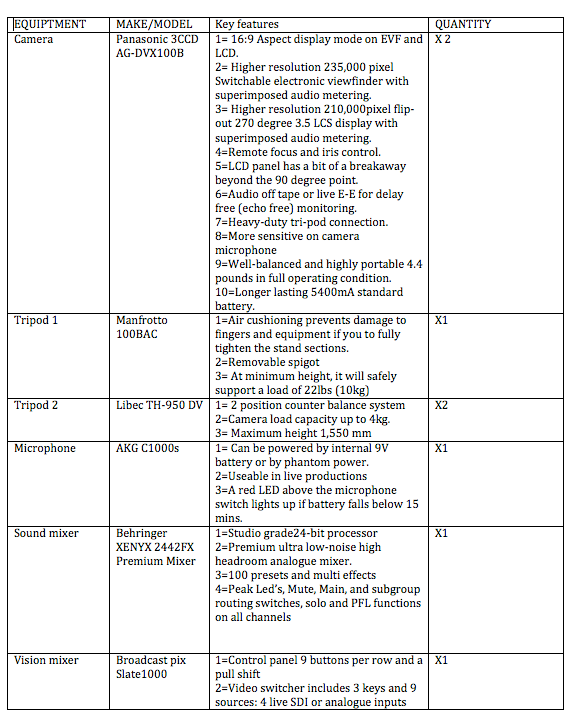
The equipment we will be using to film our advertisement is a Panasonic DVX-100-B video camera and a tripod. We will use the tripod for the majority of the shots as we want the camera work to look steady and professional. The lighting will be mainly diegtic throughout the production however we may add some non-diegetic lighting during the editing process. As we will be using a voice over in the advert, we may use a Edirol R-09 voice recorder to improve the quality of the sound.
The software we will use during the editing process will mainly be iMovie, which we will use to edit the footage we have shot and add the effects, titles and non-diegtic music we require. The sound which we recorded using the voice recorder, we will edit on garageband, which we can also use to add sound effects and we may use garageband to create the music for our advert. For more advanced editing we may use final cut express, as it allows you to have more complicated effects.
There will be 3 people involved in the filming of our advertisement. This will include monitering the camera, props and sound equipment at all times. We will not be using any actors as the people who appear in our advert will be the students and staff from grangefield art department and the majority of the filming will take place here. However we may use a different room for the interview which will become the voice over.
Task 17 (P1,M1,D1)
Here is the Storyboard we created for our advert:
Task 18 (P1,M1,D1)
Task 20 (P1,M1,D1)
Here is our finished Advert:
Task 21 (P1,M1,D1)
Evaluation
Purpose:
The purpose of our advert was to show the benifits and facilities of the Grangefield Art department to encourage students who are thinking of taking up Art as a GCSE or A-level subject. I think we acheived our purpose as we portrayed the Art department to be a very creative, friendly environment to work in and that the staff are extremely helpful. We asked a selection of members from our target audience to watch our finished advert and give their opinions;
"I liked how it was quite informative, but not dull"
"It had a nice variety of shots and a lot of colour, which made it interesting"
"Good choice of music, it was very catchy and went well, the only suggestion for improvement I have is that the voice over sounded a little muffled towards the end"
Audience:
From the feedback we collected from the audience, it seems that our advert had the desired effect and they got the preffered reading. Overall the feedback was positive with the general view being that we used a variety of shots and a lot of colour which was essential for promoting the Art Department. I agree with the statements that the audience gave us as we did have technical difficulties with the sound for the voice over.
Representation issues:
The messages we gave were positive as our purpose was to show the benifits of the art department and how it is a colourful create place and people are proud to be part of it. Therefore it was important to give out positive messages. As it is an advertisement, we were a little baised it is to encouage students to take art as a subject. Our advert included both males and females and although we used a female student for the voice over, this person was picked at random without reference to gender.
The music tracks we used were effective in adding to the mood of our advert. We used a catchy, up-beat track at the beginning which was important as it grabbed the audiences attention from the beginning. Then throughout the advert we used a variety of tracks to keep the audiences interest and to show the diversity and creativity that the art department offers. The primary location of the advert was the art department which was appropriate as we wanted to show the audience what the art department is actually like. We used the schools TV studio for the interview which we used as the voice over so the quailty of the sound would be better and we would have little interference. Also it has a colourful backdrop which was appropriate as it was actually created by art students from the school.
Our advert was realistic for the genre as we used a lot of colour and a range of music which connotes the creativity of art as a subject. The only language used was the voiceover which was appropriate for our target audience as we used a student who goes to Grangefield so their accent was familier to the audience.
Technical issues:
We did experience technical difficutlies with the sound of the voice over for our advert. We filmed the interview with a camera in a sound proof room therefore we didnt have any problems with interference and ambience so we felt that an external microphone wasn't needed. However when it came to editing, the sound came out much quiter than expected, and the music we used made it difficult to hear the voice. To solve this problem we imported the sound to Audactiy and amplified it. This improved the volume of the sound so this issue was resolved without difficulty.
I feel that our camerawork was effective and creative. We used a variety of angles and shots to show the art department, and film the students work. The only trouble we had was that we had to work around the lessons which were going on in the art department at the time therefore we had limited time to get the shots we wanted. However i think that the footage we did get had enough variety to create an interesting advert. The transtions and effects we used during the editing process, i feel made the advert more interesting to watch. For example we used effects such as fast-forward, white wash and fade which made the clips we used flow. We were careful not to use too many transitions as it may have become too confusing and unrealistic for the audience.
Conventions/Narrative:
The things that i think are typical of this genre are:
-Medium shots of people
-Upbeat music
-Panning/Crab shots
-Voice over
-Fast forward/Slow motion
-steady shots
I think that overall we managed to achieve these in our advert. The music we used for the advert are similar to what a professional production would use as it is catchy and upbeat, which is important for an advert to have. Professional Producers have many advantages over us. One of these is that they have bigger budgets to work with which means the quality of their equipment etc. would be better than ours. Also they have more experience and a team of professionals behind them so the advert would be finished much quicker.
Self evaluation and future targets:
Throughout the production of our advert i feel that i did well when it came to being more creative will the camera angles for the shots as it was important that we had a variety of shots to work with. I think the filming of the advert was my strongest point as i had a lot of ideas about how we should shoot it. I think this also applys to the editing process as i had a number of ideas on what effects and transitions we should use, however i still worked well with my team members and was able to listen to their ideas also. I think my weakness would be that i was not at familiar with the editing software than my team members, however as time went on, my skills with software such as imovie improved.